Warm Introduction Playbook: Earn Permission First
A practical warm intro playbook that separates an honest relationship, a forwardable note, and permission before an introduction.
By HeyWarmLead Team, Product team
The team that builds HeyWarmLead, the lead-state, relationship-temperature and approval backend that AI assistants work through over MCP. We write about running a small, researched pipeline where a person reviews planned outreach and chooses the next step.
On this page
How do you ask for a warm introduction without putting your contact on the spot? Ask privately whether they are comfortable helping, give them a short note they can forward, and let them check whether the recipient wants the connection before anyone starts a shared thread. Keep those decisions separate. A note can be ready while permission is still missing.
A useful warm introduction depends on three checks: an honest account of the relationship, a note that gives the recipient enough context to decide, and consent before the two people are joined. Fred Wilson’s 2009 double-opt-in guidance anchors that consent step by asking permission before the introduction. This three-check rule is an editorial synthesis of practitioner guidance, not a tested conversion sequence.

A ready note can wait while the recipient decides.
A shared contact is not an endorsement
Does knowing a mutual contact mean you can use their name? No. A shared connection does not automatically give you permission to speak for that person, and it does not mean they can honestly recommend your work. Ask whether they are comfortable making this specific introduction, then leave room for them to describe the relationship in their own words.
In his guide to email introductions, Adam Grant advises giving the people being connected clear context about how they know one another. The distinction matters when the relationship is thin. A connector who worked with you on one project can describe that limited contact without claiming to vouch for all your work. The connector should choose what they can honestly say, if anything.
A useful private request names that boundary instead of hiding it. If your contact cannot identify a real reason to connect you, take that as information. Try a more relevant person, or use a public contact route that does not ask the mutual contact to stand behind you.
Give the connector two separate messages
What belongs in a forwardable note? Your identity, why this recipient is relevant, the small next step you want, and an easy way to decline. Keep it separate from the private request to your contact. The first asks for help and gives the connector room to say no; the second can be forwarded without the connector having to draft your case for you.
Ben Werdmuller’s account of the forwardable email, published January 22, 2026, describes the note as context that helps the recipient make an informed decision. Werdmuller credits Corey Ford for the template and says that checking first makes the process slower. This is practitioner guidance, not evidence that a particular template improves reply rates.
Hypothetical example. Ren, Jules, Kai, and Moss Harbor Studio are fictional.
Private request to Jules, the connector:
Jules, would you be comfortable checking with Kai at Moss Harbor Studio about a short conversation? We met during one volunteer shift, so please say no if this is not a connection you can comfortably make. If you are open to checking, I have drafted a separate note below. Please do not forward anything you would not choose to send.
Separate note Ren offers for Jules to forward:
Hi Kai, I’m Ren, an independent researcher. I’m looking at how small design studios decide which customer questions need interviews, and your work at Moss Harbor Studio seems relevant to that question. Would you be open to a 15-minute conversation about how you scope that work? If not, no problem.
The sample does not put words in Jules’s mouth or claim Jules endorses Ren. If Jules chooses to add context, that context belongs to Jules and should reflect the actual relationship. The requester owns the note; the connector owns any statement made in their own voice.
Wait for both answers before opening a thread
When should the connector add both people? Only after both have opted in to this specific introduction. Your request tells the connector that you want it; the connector still needs to check that the recipient wants it too. A forwardable note makes that check easier to conduct, but it cannot stand in for the answer.
Fred Wilson’s double-opt-in introduction guidance, published November 3, 2009, recommends checking with each person before making the introduction. Adam Grant’s guidance also advises asking both parties. These are practitioner recommendations, not measured evidence that the extra step produces better business outcomes.
The order is simple: ask your contact privately, let them decide whether they are comfortable, let them check with the recipient, and start the shared thread only after the recipient agrees. If the recipient declines or does not answer, stop there. Silence is not permission; treating it that way is a conservative editorial rule, not legal advice.
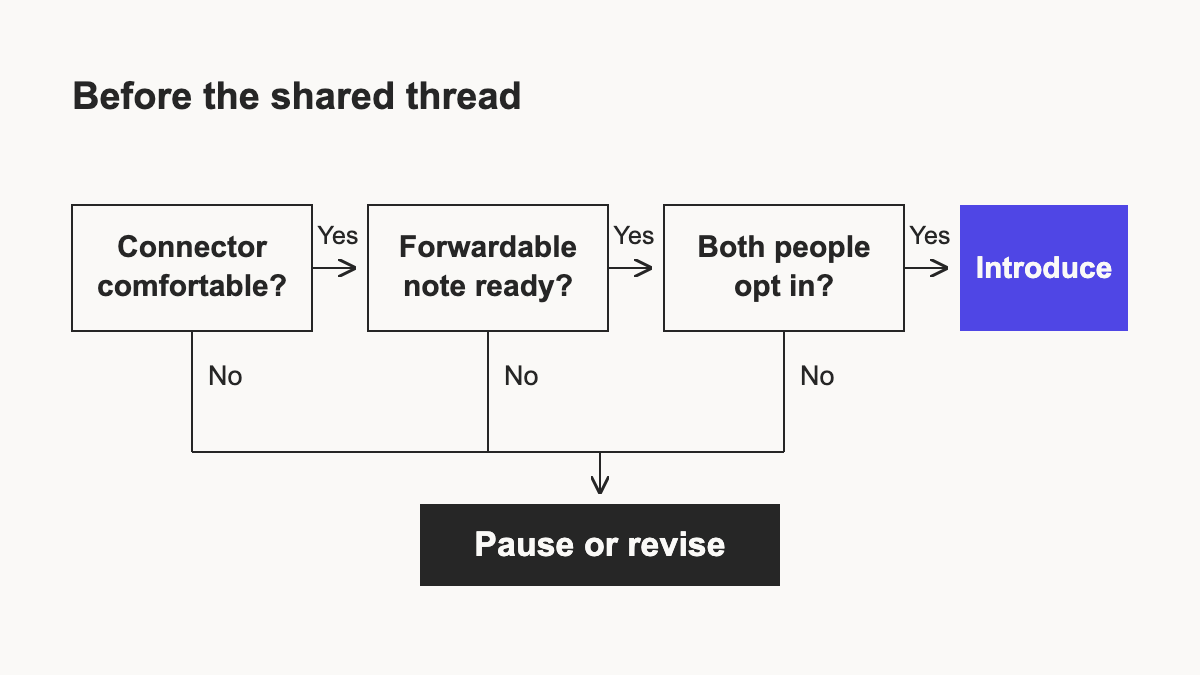
A decision aid synthesized from Grant, Werdmuller, and Wilson; no step promises a reply.
Keep the warm route optional
Is the extra step worth the delay? Sometimes, and not every situation needs it. The strongest objection is practical: permission checks add messages, time, and work for the connector. Werdmuller acknowledges that a double opt-in is slower. Do not turn that into a ritual when the decision has already been made. If both people have already explicitly agreed to this exact introduction, treating that specific consent as enough is a reasonable editorial judgment, not a rule established by the sources.
That exception is narrow. Permission for one introduction is not permission for an endorsement, a sales campaign, or a chain of follow-ups. If the recipient or request changes, ask again. The sources do not establish a universal reminder interval, so this playbook does not prescribe one.
When should you skip the warm route? If the connector is uncomfortable, cannot describe a genuine relationship, or sees no clear reason the recipient would want the conversation. A direct route may be better when the recipient has published a relevant contact method. That can take more effort from you, but it does not ask someone else to imply a relationship they cannot stand behind.
Before you ask, check the relationship, prepare a note the recipient can judge for themselves, and leave the shared thread until both people are willing. Which part of your next introduction request still needs a decision: the relationship, the note, or permission?
Related posts
Lead Management
What Is a Warm Lead? Examples and How to Follow UpA warm lead has shown relevant interest, but may not be ready to buy. Learn which signals matter, how to qualify them, and what to do next.